Listen to your people
A structured assessment explores how it feels to work in the team. People can save their progress and return when they’re ready.
A clearer view of team performance
Understand what helps your team thrive. Find what’s holding it back. Choose what to do next.
Better questions. Useful conversations. Practical progress.
37performance factors
6dimensions of team life
1shared starting point
From insight to action
Bring people’s experience, team performance and your organisation’s culture into one useful view.
A structured assessment explores how it feels to work in the team. People can save their progress and return when they’re ready.
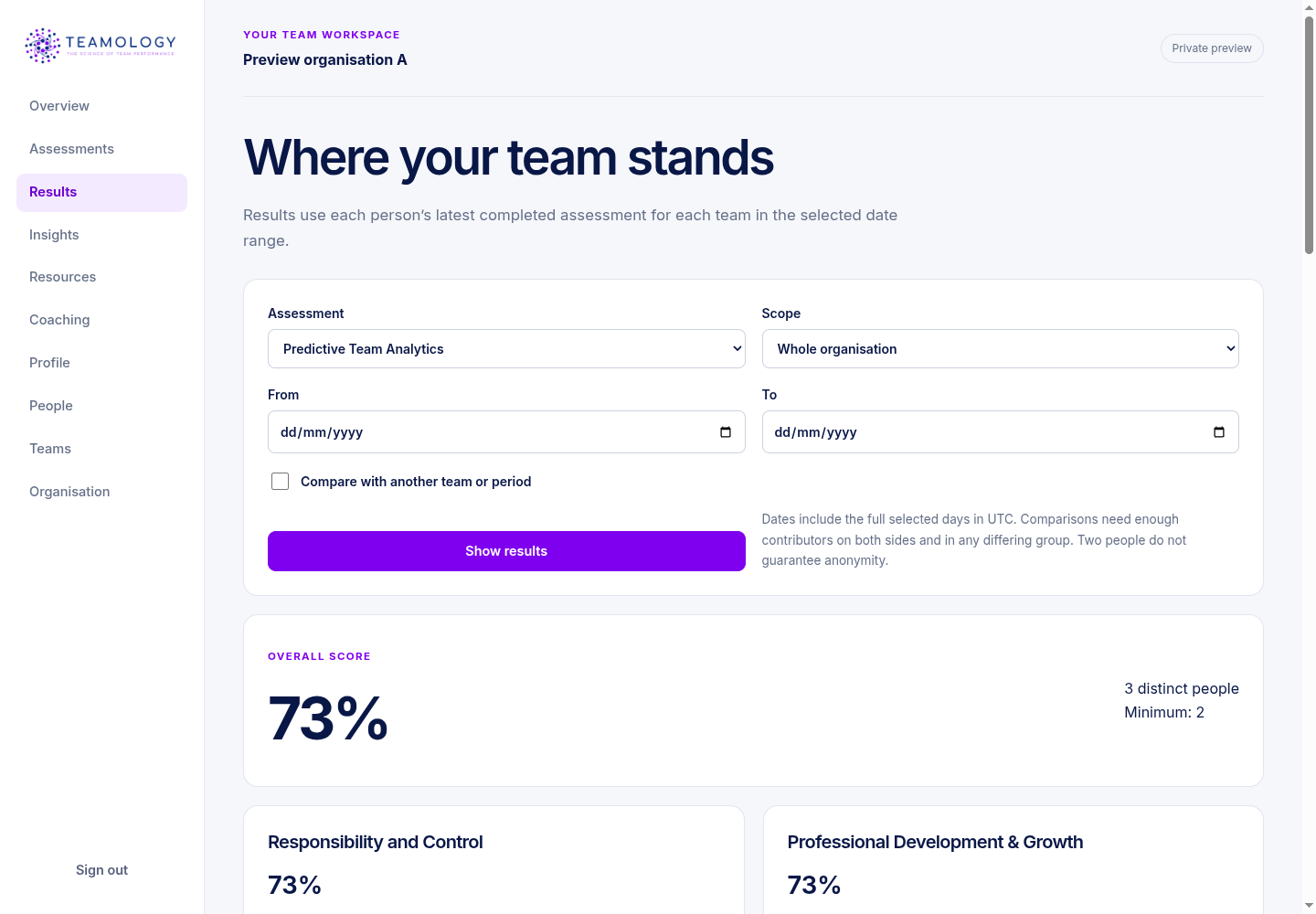
Look at strengths and areas to improve across six dimensions. Compare permitted teams and periods, with contributor checks built in.
Use practical guidance to shape your next conversation. Bring your culture priorities into AI-supported coaching when it is enabled.
A shared picture
Move from an organisation overview to the factors that matter to a team. Keep the date range, scope and contributor count in view.
Built for useful conversations
Teamology explores the conditions that help people do good work together. The assessment gives you a starting point for discussion, not a diagnosis or a promise of future performance.
Let’s talk about your teamPeople and culture
Teamology’s AI-supported coach can draw on an MBTI profile, permitted colleague context, team results and your organisation’s culture priorities. Profiles describe preferences, not limits.
AI suggestions support your judgement, rather than replacing it.
Access follows organisation and team roles. Results need a minimum number of distinct contributors, with extra checks for comparisons. A small-group threshold is not a guarantee of anonymity.
How information is handled ↗Start with your team
Book a one-hour, no-obligation conversation about your team and what you want to change.
Let’s talk about your team